
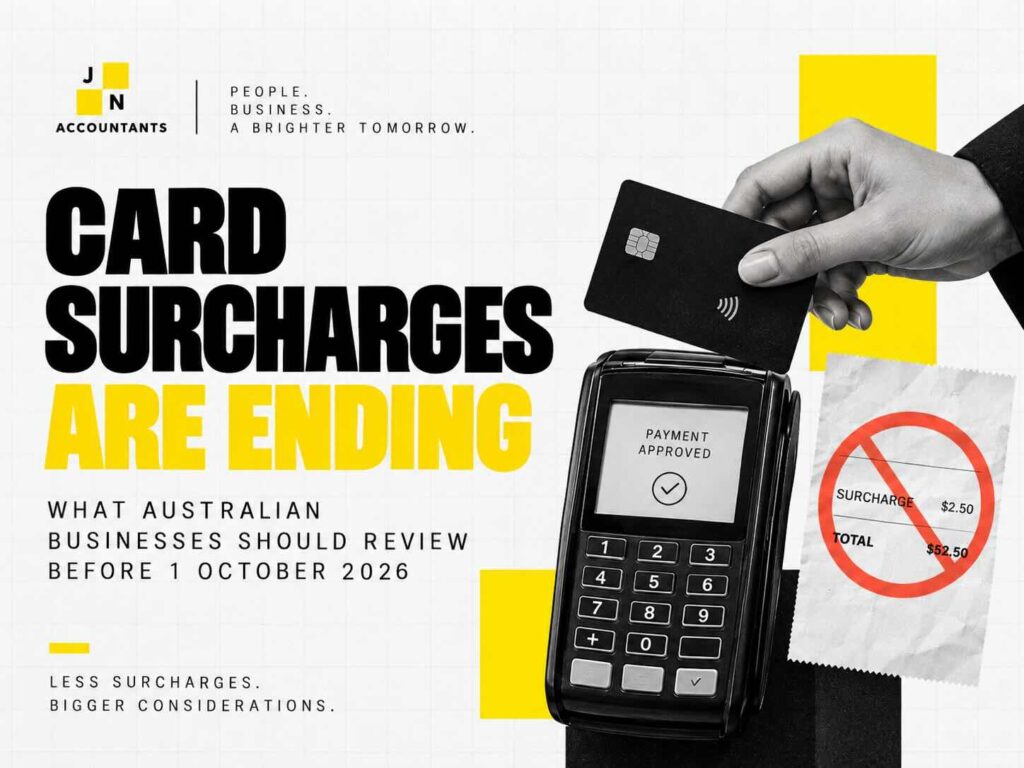
From 1 October 2026, Australian businesses will generally no longer be able to add a surcharge when customers pay using eftpos, Visa, Mastercard or American Express cards.
For businesses that currently pass card processing costs on to customers, this could affect pricing, margins and cash flow.
Now is a good time to understand what card payments are really costing your business and decide how those costs will be managed once surcharging is removed.
What Is Changing?
From 1 October 2026, major card networks will introduce rules that generally prevent businesses from applying a surcharge to card payments made through their networks.
Card payments will continue as normal. What changes is the ability to separately pass the processing cost on to the customer as a card surcharge.
The Reserve Bank of Australia has also introduced changes to interchange fees aimed at reducing some of the underlying cost of accepting card payments.
However, businesses may still incur merchant and processing fees, so it remains important to understand the actual cost to your business.
Why This Matters?
Removing the surcharge does not necessarily remove the cost of accepting card payments.
For example, if a business processes $500,000 in card payments each year at an average processing cost of 1.5%, that represents approximately $7,500 per year in card processing fees.
If most of that cost is currently recovered through customer surcharges, the business will need to decide how it will be managed from October.
Some businesses may choose to absorb the cost. Others may decide that a broader pricing review is appropriate.
Before making changes, consider:
- how much you currently pay in card processing fees;
- what proportion of sales are paid by card;
- how much surcharge income you currently recover;
- your existing gross margins; and
- how sensitive customers may be to price changes.
Simply adding the old surcharge percentage to every product or service may not be the best commercial response.
Review Your Merchant Fees
The end of card surcharging is also a good opportunity to review what your business pays to accept card payments.
It may be worth checking:
- your effective merchant fee rate;
- whether fixed transaction fees apply;
- whether different card types attract different costs; and
- whether your current provider remains competitive for your transaction volume.
Reducing the underlying cost of accepting payments may help offset some of the impact of losing surcharge income.
Businesses may also want to consider lower-cost payment methods such as bank transfer, PayID, direct debit or PayTo where appropriate.
Any changes to pricing, discounts or payment terms should be clearly communicated and appropriately structured.
What Happens in Xero?
For businesses using Xero invoices with card surcharges enabled, Xero has advised that card surcharges will stop automatically from 1 October 2026.
Customers will still be able to pay by card, but the surcharge will no longer be added.
Xero has also announced changes to domestic card pricing for eligible Australian Stripe accounts managed through Xero from the same date.
Businesses should check their current Xero and payment-provider pricing to understand how the changes will apply to their own account.
Businesses using separate EFTPOS terminals, merchant facilities or other payment providers should confirm their provider’s arrangements before the change takes effect.
Five Things to Review Before 1 October
- Understand your card processing costs
Review the last 12 months of merchant and processing fees to determine the true annual cost of accepting card payments. - Calculate your current surcharge income
Understand how much of your processing cost is currently being recovered from customers. - Review your margins
Consider the impact on gross margin if the business absorbs some or all of the processing cost. - Compare payment providers
Check whether your existing merchant facility or payment provider remains competitive. - Update your systems and communications
Review invoices, websites, payment terminals, checkout pages, signage and any references to card surcharges.
The Real Issue Is Your Margin
For most businesses, the key question is not simply:
“Can we still charge a card surcharge?”
It is:
“What happens to our margin when we can’t?”
The answer will be different for every business.
Businesses with high card turnover, lower margins or significant online payment volumes may benefit from reviewing the numbers before 1 October rather than waiting until the change takes effect.
How J&N Accountants Can Help
J&N Accountants can help business owners understand the commercial impact of the surcharge changes, including:
- reviewing merchant processing costs;
- calculating current surcharge income;
- assessing the impact on gross margins;
- modelling different pricing scenarios; and
- reviewing potential cash flow implications.
If your business currently passes card processing fees on to customers, now is a good time to review the numbers and make sure your pricing remains sustainable after 1 October 2026.
Get Expert Advice Today
Fill in the form below to book a budget impact review for your business.